


Almonds, the Story of Its Origin and Varieties
General Information- 1Almond botany
- Other Varieties
- 2Where do almonds come from?
- 3Sweet and bitter
- 4Almonds Origin and history
- 5Production
- 6Uses of almonds
- Oil
- Syrup
- 7Nutritional and Culinary Uses
- Queen Almond Pastry
- Sholeh Zard
- Haji Badam
- Morasa Polo
- Harireh Badam
- Khoresh Khalal
- Gheymenasar
- 8Medicinal Uses
- 9Almonds in Iranian medicine
- 10Properties of Sweet Almonds in Iranian Traditional Medicine
- 11Properties of Bitter Almonds in Iranian Traditional Medicine
- 12In Arabic Medicine
- 13In Indian Medicine
- 14Other uses
- 15Cultural Importance
- 16Cultural Significance
- 17Global Trade
Where did almonds come from? Where does the story of this plant begin and in which regions does it have its roots? How far can we trace its history? The extensive development of almond cultivation in recent decades has more than quadrupled its production in the past 30 years. It is obvious that this plant play an important role in the diet of modern society and it is of particular importance to know these things about it.
Porfiro begins the story of this product from its very origins. In this article, in addition to recounting the story of the origin of this plant, it also introduces various types of it to its valued audience, because it deeply believes that knowledge is one of the fundamental rights of the audience and has always placed great value on awareness in its activities. Let’s travel in this article through the history of this plant!
Almond botany
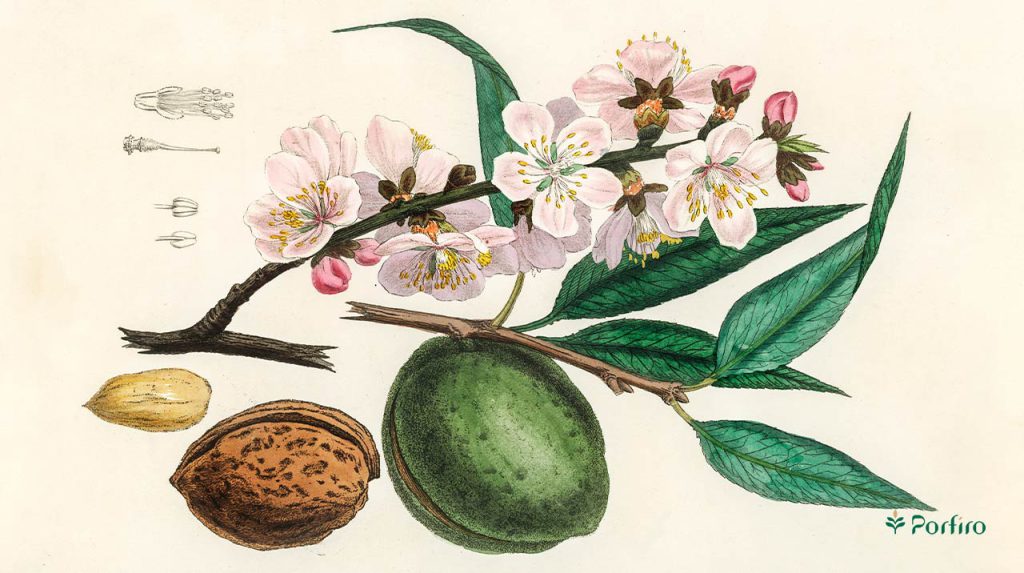
This plant is a small deciduous tree scientifically known as Prunus amygdalus, Prunus dulcis, or Amygdalus communis. It belongs to the subfamily Prunoideae of the Rosaceae family. There are primarily two major varieties of this plant:
- Sweet: It is edible, which includes those varieties that are consumed raw, roasted, or pressed for almond oil.
- Bitter: (Prunus amygdalus var. amara), which is used for its oil but when consumed raw may produce dangerous quantities of prussic acid – hydrogen cyanide – from the action of the enzyme emulsin on a soluble glucoside, amygdalin.
Other Varieties
This plant can also be classified into two types:
- Thin-shelled almonds: Paper shell, Sultanina, and Marcona
- Ordinary almonds
Almonds perform very important roles in the ecosystem and play a very significant role in human health. Ecologically, the pollination of this plants may be described as mutualistic with its bee population. Almonds, its oil and syrup are nutritious varieties of food used in various culinary manners. Almonds have been described as a nutritional powerhouse, given that they are a rich source of protein, riboflavin, vitamin E, copper, niacin, calcium, fiber, folate, magnesium, potassium, and other forms of nutrients. It is also used in many medicinal ways.
Where do almonds come from?
Several variants of this plant are grown in Iran, of which the following may be mentioned:
- Ivory or Gray
- Leafless or Peacock
- Turkmenistan
- Urmia
- Kermani in Lorestan, Kerman, and Fars
- Taftani or Baluchi
- Karabakh
- Meshed of Fars
- Ravandouzi or Chaghalak
- Thorny or Tangeres or Badamak
- Velvet in Azerbaijan
- Khormooji
- Zagros
This plant is a member of the genus Prunus, a group that also includes plums, cherries, peaches, and apricots. There are approximately 430 species of Prunus, ranging throughout the temperate regions of the Northern Hemisphere. The genus Prunus is a member of the rose family, Rosaceae-an extremely large family of flowering plants with approximately 3,400 members. Besides all the ones mentioned above, it also includes such significant plants as apples, mulberries, and hawthorn trees, among many others.
It is classified with the peach in the subgenus Amygdalus of the genus Prunus distinguished from the other subgenera by corrugations on the seed shell. Other related species in the genus are plums and cherries; but in these, the fleshy outer covering is sweet and edible; the almond has instead a leathery covering that contains an edible kernel often referred to as a nut in culinary usage. But that’s not their botanical status. In the strict botanical sense, they are not nuts. The hard, pitted shell is an endocarp and the fruit or exocarp is a sort of drupe, having a fuzzy outer covering.
The height of this tree can grow up to 4 to 9 meters. Leaves are lanceolate, reaching sizes of 6 to 12 centimeters in length and serrated along the edges. Flowers are white or pale pink, 3-5 centimeters in diameter, five-petaled, appearing before leaves at the beginning of spring.
Sweet and bitter
This plant exists in two forms: one-with white flowers-produces sweet almonds, and the other-with pink flowers-produces bitter almonds. The kernel of the former contains oil and emulsion. In the late twentieth century this oil was used internally in medicine. This oil is relatively popular in alternative medicine, especially as a carrier oil in aromatherapy, but today it is less commonly used directly as a remedy within the medical community.
Bitter kinds are relatively wider and shorter than sweet variety and contain about 50% of the fixed oil that is also contained in sweet types. They also contain the enzyme emulsin that acts on the soluble glucoside amygdalin in the presence of water, producing glucose, cyanide, and the essence of bitter almonds or benzaldehyde. Bitter kind can produce between six to eight percent hydrogen cyanide (prussic acid).
Bitter almond extract at one time was employed medicinally, but its action is intense even in small doses and lethal with larger doses. The prussic acid herein contained must be eliminated before the nuts are consumed. Heating the nuts neutralizes the toxicity of the prussic acid in bitter almonds; however, sale of bitter almonds for any purpose is prohibited under United States law.
Almonds Origin and history
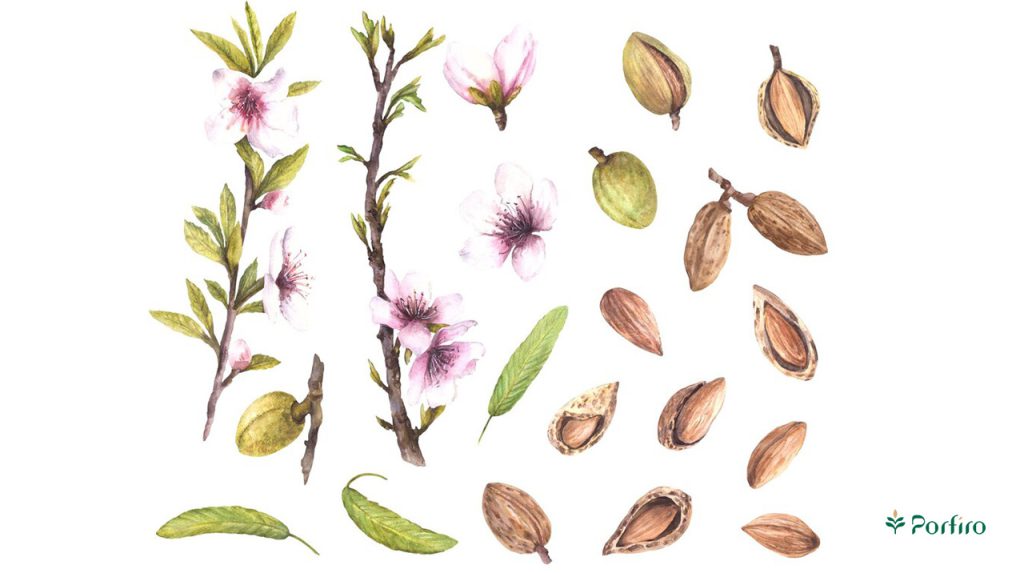
The origin of the this famous plant is in the western regions of Asia and China, where it was likely cultivated. The almond tree is native to Southwest Asia and is particularly abundant in Iran. Its domesticated form can be observed as far north as the British Isles. The wild form of the domesticated almond grows in the Mediterranean region in parts of the Levant.
It has been said about the history of almonds that they were first cultivated in this area. Domesticated almonds appeared in the early Bronze Age (3000-2000 BC) in the Near East or possibly a little earlier.
Although the exact location of domestication is not clearly established over time, based on linguistic evidence and writings, especially Greek and other Eastern texts, scholars recognize Western Asia or Asia Minor as the most likely locations where these trees first grew. Even today, wild ones still exist in modern Iran and neighboring countries, and they continue to grow there.
In various texts regarding the Babylonian civilization, the earliest historical evidence related to this plant is frequently mentioned. Writers such as Theophrastus the botanist and Dioscorides have also referred to almonds several times. The names Paladius and Columella, by which almonds are sometimes known, are actually translations of the Greek name previously chosen by Theophrastus and Dioscorides.
In archaeological remains from a sunken ship off the coast of Mallorca in Spain, three almond fruits and some pieces of green almond shells dating back to around the 4th century BC were found; these almonds are visually very similar to the Pou variety, which is still cultivated in this region today. This plants were known and cultivated in Greece in the 4th century BC and gained significant attention from the Roman Empire in the 1st century AD. It was during this time that grafting techniques were also employed for them.
Experts believe that they were among the first domesticated trees, as cultivated almonds appeared in the early Bronze Age (around 3000 to 2000 BC) in Numaira, Jordan. The name almond is mentioned in the Bible, and a well-known archaeological example of them includes fruits found even in the tomb of Tutankhamun (around 1325 BC) in Egypt, which likely came from the Levant. Ultimately, almonds were spread by humans along the Mediterranean coasts, both in southern Europe and northern Africa.
Before cultivation and domestication occurred, wild almonds were harvested as food and were undoubtedly processed by washing or roasting to remove their toxicity. However, the sweet forms of domesticated almonds are not toxic. Scientists believe that a common genetic mutation led to the absence of the glucoside amygdalin in almond seeds, and this mutated variety was initially unintentionally cultivated among the wild trees and later intentionally in their gardens by early farmers. Almonds are referred to as “lawz” in Arabic, and in addition to Persian, they are also called “badam” in Urdu and Hindi.
Production
According to the Food and Agriculture Organization report, global production of this nut is about 1 to 1.5 million tons per year. Major producers include Australia, Greece, Iran, Italy, Morocco, Portugal, Spain, Syria, Turkey, and the largest producer in the world-the United States.
In Turkey, most production comes from the Datça Peninsula. The different types of sweet almonds are produced commercially in Spain; among the more important varieties are Jordan almonds, originally imported from Malaga, and Valencia almonds. Production within the United States is concentrated in California, where it rank as the sixth-leading agricultural product and leading agricultural export. California almond exports, valued at more than one billion dollars annually, account for about 70 percent of California’s total almond crop.
California almonds are the world’s single largest managed annual pollination event; almost one million hives – about half of all hives in the United States – are Trucked into almond orchards in February. A great majority of this is done by pollination brokers who contract with migratory beekeepers from at least 38 states for this event.
Uses of almonds
Oil

“Oleum Amygdalae” is a fixed oil obtained from its kernel obtained from all its varieties. It is a variety of glyceryl oleate, with a mild odor, nutty flavor. It is almost insoluble in alcohol but easily soluble in chloroform or ether and may be used as a substitute for olive oil. Sweet kind oil is extracted from the kernels of this plant after they have dried. Conventionally, this was used by all massage therapists for lubricating the skin while undertaking a massage session, and many considered it an effective moisturizer.
Syrup
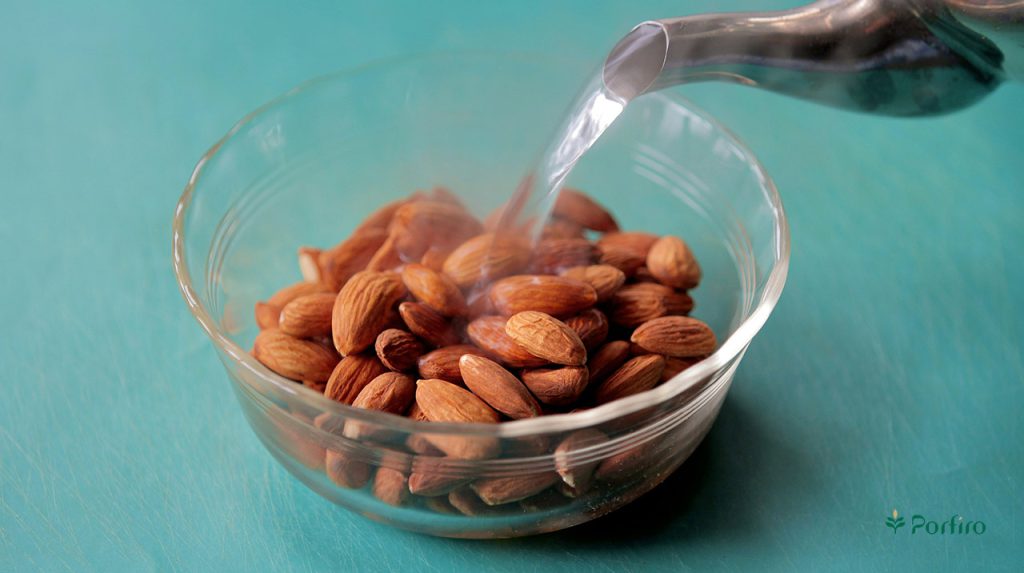
Classically, almond syrup was an emulsion of sweet/bitter ones, often flavored with barley syrup-orgeat syrup-or in syrup of sugar and orange blossom water. The Grocer’s Encyclopedia reports that “ten parts of sweet almonds are generally used for three parts of bitter almonds” for this syrup; these days, though, most syrups are made with sweet almonds only, as the bitter variety contains cyanide.
Nutritional and Culinary Uses
This nuts continued to be consumed throughout the Middle Ages, and even the Queen of France, Jeanne d’Albret, ordered almonds for various royal preparations. Almonds were included in most of the cookbooks commissioned by Richard II of England during the late 14th century. During the early 15th century, almonds were used to prepare a great many dishes in Cyprus. There are writings from the early 15th century found in Germany which referred to the preparation of pastries that contained almonds.
From the 14th and 15th century survived recipes about the preparation of different kinds of pastries and dishes that used almonds and were mainly consumed by the class of nobles. In dietary periods where cream and milk, besides eggs, were forbidden, almond milk and such derivatives often found their way to artificially enrich and thicken the food. Even an English scholar named Borde expressed in the mid-16th century that almond milk was applied as a meat substitute in the diet along with almond butter. He mentioned those two almond-derived products as well-known and used, which signifies common knowledge of these two then.
According to experts, almonds are a type of “nutritional powerhouse.” This tree nut is an excellent source of protein, vitamin B2 (riboflavin), vitamin E, copper, niacin, calcium, fiber, folic acid, magnesium and potassium, and a good source of iron and zinc. this nuts are also a good source of vitamin B1 and rich in monounsaturated fatty acids-one of two “good” fats responsible for lowering LDL cholesterol.
While sweet almonds are often consumed whole, either raw or roasted, they also find use in some foodstuffs: they are sprinkled over pastries, along with other nuts, often on desserts, particularly soups and other types of ice cream.
It is also used in the preparation of baklava and nougat, as well as marzipan-traditional European confectionery-and macaroons. But then there is also almond butter, just like peanut butter, but it is more popular due to its low-salt flavor among people allergic to peanuts.
Fresh-growing fruit of almond can be consumed whole when it has a green, fleshy outer skin, and the inner shell is not hardened. The taste is a bit sour at this stage and is only available from mid-April to mid-June. The life is extended with the help of pickling and brining.
Sweet varieties contain virtually no carbohydrates and can be ground to cake and cookie flour for low-carb diets or diabetics or any type of glycosuria. A typical serving of almond flour for one serving size of 1 cup contains 20 grams of carbohydrates, 10 grams of which is dietary fiber. This feature makes the almond flour very desirable for use in cake and bread recipes by those on restricted carbohydrate diets.
This nut can be made into a dairy milk replacement, more commonly referred to as almond milk. Its fragile texture, meek flavor, and pale skinless color make them an apt substitute for dairy products, and a soy-free alternative for lactose-intolerant people, vegans, and others. Raw, blanched and light roasted almonds can be used depending on the production process, and indeed some processes are very similar to soy milk, and in the processing of some there is no real use of heat, hence “raw milk” production.
Originating in Spain but now being spread to North America and other areas, this variety is much shorter, rounder, sweeter and softer in texture than other varieties. Traditionally the Marcona almonds are fried in a little oil and then served. The Spanish chefs also use them to make a dessert called turrón or Spanish almond nougat, which is often called a Christmas specialty.
In China, they are used to make a popular dessert mixed with milk and then served warm. In Indian cuisine, almonds form the basis of an important curry-style dish known as pasanda.
But more than any other country in the world, almonds have been used in Iran to prepare a variety of foods, pastries, sweets, and snacks. As a matter of fact, here are just some of the delicious Iranian snacks that include almonds or its slivers:
Queen Almond Pastry
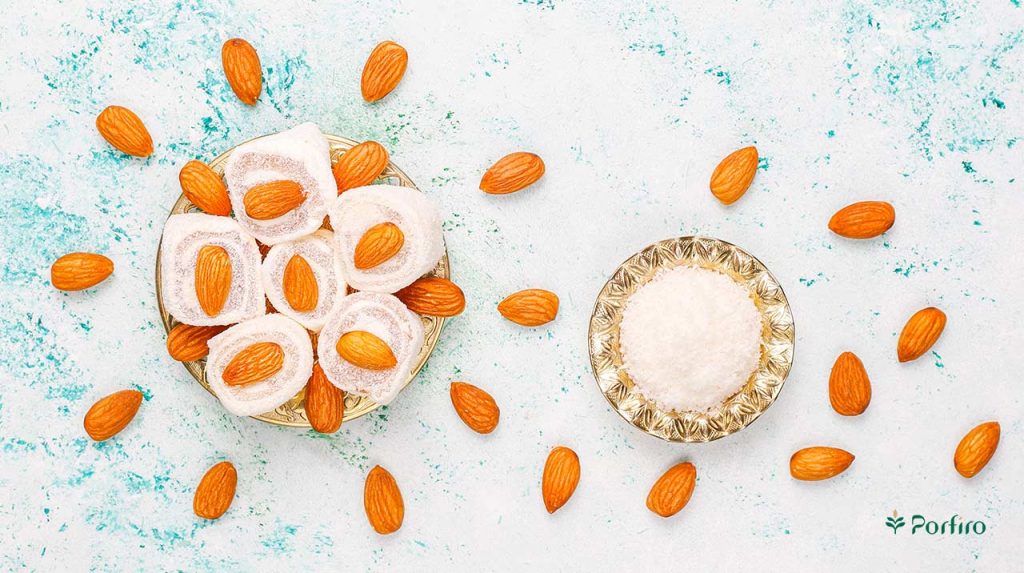
One of the oldest types of traditional Iranian sweets, made with butter, flour, powdered sugar, eggs, cardamom powder, cream, and other rich ingredients such as saffron, honey, butter, and slivered almonds. This sweet is also prepared as a cake.
Sholeh Zard
One of the most famous Iranian desserts that has also entered religious and cultural ceremonies.
Haji Badam
Made in some central cities of Iran, such as Naein and Yazd. This sweet is made with almond kernels, powdered sugar, wheat flour, sugar, chickpea flour, eggs, cardamom, and nutmeg.
Morasa Polo
Also known as “Necklace Rice,” this special mixed rice dish is one of the traditional foods of Shiraz, and similar versions of this dish are served in Qazvin and Khorasan. It gets its name from the brilliant garnishes mixed into it. This rice is prepared with white rice and saffron, combined with various small fresh or dried fruits such as sour cherries, green and red raisins, pieces of dried apricot, slivers of dried green pistachios and almonds, citrus peel, chicken, and various proteins, all lightly sautéed in butter.
Harireh Badam
According to Dehkhoda’s dictionary, Harireh is defined as a dish made with rice flour, sugar, and milk, sometimes with crushed almonds, and sometimes with starch, sugar, and milk. The differences between almond harireh and flour harireh and starch harireh are noted. This dish is essentially a type of thin porridge made by cooking grains or nuts in water or milk, and Harireh is usually a type or combination of legumes or almonds cooked with water or milk.
Khoresh Khalal
Almond sliver stew is a Kurdish dish cooked in Kurdish regions, especially in Kermanshah. This stew is made with slivered almonds along with meat, black barberries, saffron, rose water, cinnamon, and dried lime, as well as a small amount of wheat flour to thicken the stew. The people of Kermanshah use Kermanshahi oil in its preparation.
Gheymenasar
Gheymenasar is a dish originally from Qazvin. This dish is made with rice, meat, slivered almonds, slivered pistachios, slivered bitter orange, fried onions, and barberries. In Qazvin, there is a spice known as “Gheymenasar spice,” which, if a high-quality type can be found, makes the dish incredibly fragrant. This dish was once considered a ceremonial food and was served at weddings as a wedding dinner along with fresh herbs.
And countless other types of foods!
Medicinal Uses
This nuts have been widely used as a medicine throughout history and from ancient times. Hippocrates in the 5th century AD and Pliny in the 1st century BC mentioned the medicinal uses of almonds. In the medical texts that have survived from the Roman scholar Scribonius, who lived in the early 1st century AD, it is noted that bitter almonds were used to relieve headaches, tumors, and similar ailments.
The ancient Romans also prepared an ointment from bitter almonds that was used to protect dogs from insect bites. Additionally, studies by a scientist named Dioscorides indicate that he conducted research on the beneficial effects of almonds in alleviating liver, kidney, and respiratory disorders. He also used almond oil as a laxative and a treatment for bladder stones.
Almonds in Iranian medicine
In Iranians’ rich and traditional medicine, they have had various applications mentioned in different sources. Iranian physicians described the this kernel as warm and moist and in some references, moderate. Muhammad ibn Zakariya al-Razi had noted almonds in one of his magnificent, eternal masterpieces entitled “Manafie al-Aghziyah wa Dafa Mudarraha” or “The Benefits of Foods and the Prevention of Their Harms”.
Razi said, “The heat of almonds is moderate and its digestion slow, useful for chest and lung and is taken for bladder and intestine inflammation. Their movement is aided by sugar from Tabarzan, Khosravi sugar and rose water that dispatches them quickly from the stomach and intestines.”. “If a person experiences heaviness after eating plenty of almonds, he should drink honey water, and if more fresh almonds are taken, then a person should take cumin as the heaviness of almonds will be relieved by it.”
Properties of Sweet Almonds in Iranian Traditional Medicine

All parts of sweet almond trees, especially its blossoms, leaves, fruits, etc., are utilized in traditional medicine.
- they are laxative and their oil is anti-constipation.
- they soften the chest.
- Its milk is useful for relieving coughs, throat discomfort, and shortness of breath and acts as an expectorant.
- They strengthen sexual power, are beneficial for stomach pain, coughs, insomnia, intestinal and bladder ulcers, and diarrhea.
- Green ones strengthen the gums and roots of teeth.
- Infusion of brown skin of its kernels relieves pain and inflammation of the respiratory system.
- A decoction of their leaves is good in cases of insufficiency of the liver and gallbladder.
- Smearing skin with its oil removes inflammation and burns.
Properties of Bitter Almonds in Iranian Traditional Medicine
Crush bitter almonds and mix with vinegar; this is a good treatment for headache and application around the eyes is beneficial to strengthen the sight.
Bitter almonds eaten help in shortness of breath, coughs, and pneumonia, while consumed with honey, they cleanse the liver and spleen.
Face blemishes are removed with bitter almonds beaten and moistened with vinegar, then applied to the body. This oil is useful against shortness of breath, whooping cough, pain in the kidneys and for removing stone from the bladder. The aforesaid cracks in hands and feet due to cold are also soothed.
In Arabic Medicine
Arab physicians have prescribed the consumption of almonds as a laxative, stomach and chest strengthener, sore throat reliever, and as a purifier and healer for the intestines. Additionally, Arab pharmacologists considered almonds to be a beneficial food for addressing sexual problems.
In Indian Medicine
In Ayurveda, the medical system of India, almonds are regarded as a nutrient for the brain and nervous system. It is said that these nuts promote high intellectual levels and longevity. Its oil is referred to as Roghan Badam in both Ayurveda and Unani Tibb (the Greek-Iranian medical system). This oil is extracted through a cold process and is considered a nourishing substance for both massage and internal consumption.
Recent studies on Ayurvedic plants have reported that almond compounds possess anti-inflammatory, immune-boosting, and hepatoprotective effects. The claimed medicinal benefits of almonds include improving complexion, enhancing the movement of food through the large intestine, and preventing cancer. Recent research has shown that including almonds in the diet is associated with increased levels of high-density lipoproteins (HDL) in the blood and decreased levels of low-density lipoproteins (LDL). Edgar Cayce, an American psychologist who is considered by some to be the father of American holistic medicine, had a strong interest in almonds. Cayce often recommended that almonds be included in the diet in his writings.
Other uses
This nuts have numerous medicinal, dietary, and cosmetic applications and are widely used. Almond oil possesses anti-inflammatory and pain-relieving properties for treating skin conditions such as blemishes and acne, and it is also beneficial for hair treatment. its oil is effective in alleviating ear pain and pain caused by hemorrhoidal swelling.
Its oil also have extensive applications in the preparation of cosmetics, personal care products, and lotions. Today, there are over 300 different formulas that incorporate almond oil in their cosmetic preparations. they are also used to produce essences. These essences are utilized in baking, confectionery, or as a vanilla flavoring. The ability to produce a type of antifreeze and antibacterial and disinfectant liquids are also two examples of the unusual applications of them.
Other products are derived from almonds, which are known as secondary products. A significant amount of almond waste includes materials that are used to create secondary products.
These materials may include almond kernel waste (as a livestock feed supplement), such as the residue from oil extraction (meal), almond flour (obtained by grinding broken kernels and used as a protein supplement to add to bakery flour and for making pastries and dietary products), crude almond oil, and almond pomace, as well as other materials such as the thin brown skin on the kernel (as a livestock feed supplement), green almond husks (historically recognized as a livestock feed supplement), and almond wood husks (used for producing furfural, fertilizers, charcoal, activated carbon, and fuel).
Cultural Importance
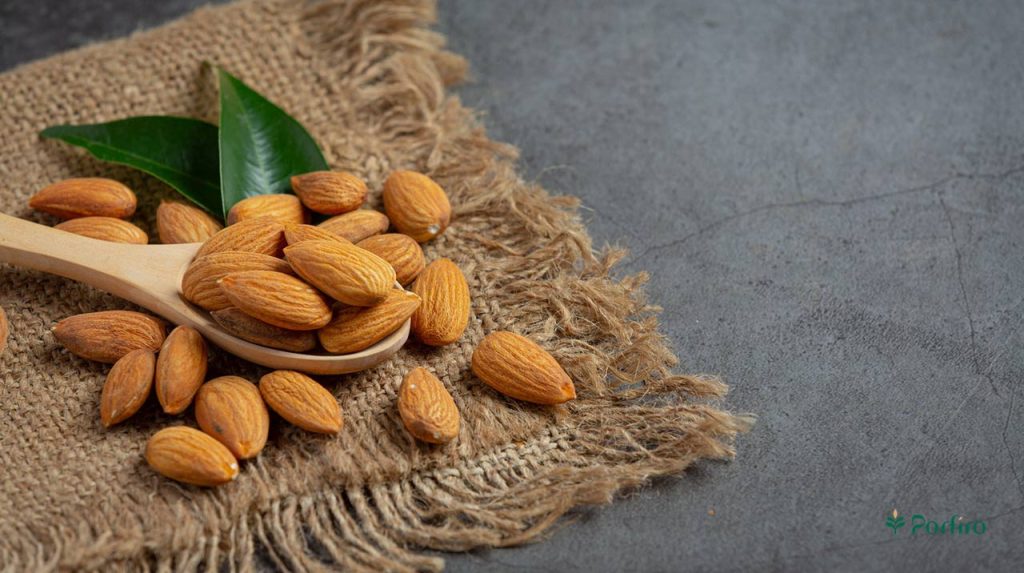
This plants are highly respected in some cultures. Masoudi, a historian and traveler of the 4th century AH, wrote in his book “Muruj al-Dhahab wa Ma’adin al-Jawahir” that:
“When Adam was expelled from Paradise, he carried a handful of wheat and thirty branches from the trees of Paradise, ten of which bore fruit: almonds, hazelnuts, and pistachios!”
Another aspect of the importance of almonds in Iranian culture can be seen in proverbs and poetry that have become common in the Persian language, where the word “almond” is mentioned. Below are some verses from very famous Iranian poets, which are just a small sample among thousands of Persian verses. Additionally, this word is frequently used in the everyday speech of Iranians.
O master, all that you give in abundance,
Fresh almonds, and apricots, and peaches, and nectarines.
Rudaki

The merchant did not bring what he claimed;
The almond's kernel was not hidden within.
Ferdowsi

Is the silver cluster more beautiful upon you, or is it the silver of the almond branch, or the branch of the sycamore?
Farrokhi Sistani

Almond is better than willow and poplar in yield,
Although the poplar grows taller.
Nasir Khusraw Qabadiani
Cultural Significance
This plant have also entered other cultures beyond Iranian culture. For example, in Christian symbols, almond branches are used as symbols related to Jesus and Mary, even as a symbol of the birth of Jesus from the Virgin Mary. Paintings often include almonds surrounding the infant Jesus and serve as a symbol of Mary.
The word “luz,” which is normally translated as “hazelnut,” appears in Genesis 30:37, but the opinion of some is that this is another name for almonds. Luz in Arabic means almond. Among the fruits known as “fruits Mendicant” and hence specifically connected with monks are almonds. Also, based on the information obtained according to historical data, four kinds of fruits were allowed to be consumed by them in the diet prepared for four Christian monks: figs, raisins, hazelnuts, and almonds.
Of course, this decision constitutes a very good nutritional balance in daily nutrition with the use of those fruits. The Chinese consider almonds as the embodiment of eternal grief and also a female beauty. So, here is the general outline of the historical existence of almonds:
- 1400 BC: They feature in Greek mythology right to the Bible. The Book of Numbers in the Bible talks about Aaron’s rod that blossomed and gave almonds. According to traditions, Aaron’s rod had sweet almonds on one side and bitter almonds on the other. If the people of Israel followed God, the sweet variety would mature and be edible but if they strayed from God’s path, the bitter almonds would prevail.
- 100 AD: The ancient Romans threw almonds over bride and groom; they believed almonds to be a kind of fertility charm, just like today’s North American custom of giving sugared almonds.
- 600 – 900 AD: Trees were so productive, even the cities of Spain, Morocco, and Greece were provided with the produce in plenty. The explorers traversed the Silk Road to China as well with the produce of the trees of almonds. And up to this very day, Spain is the only country that has had a significant almond industry.
- 1700 AD: Franciscan friars imported the almond tree into California from Spain, but the humid, cool climate prohibited successful planting until the next century.
- 1890 AD: Vincent van Gogh created a series of paintings related to the almond blossoms during his stays in Arles and Saint-Rémy, southern France. These are considered among his most popular paintings.
- 1900s AD: By the turn of the 20th century, the almond industry of California was fully established. This later gave way to a series of crossbreeding programs that developed many of the common types today.
- 2000s AD: Over the past three decades, yields from California almonds have quadrupled. Stretching over half a million acres in the rich valleys of San Joaquin, Fresno, and Sacramento.
- Today: California produces approximately 80% of the world’s almonds and is the largest export of agricultural products from the state. Almonds are the largest tree nut crop in dollar value and acreage. They are also ranked as the largest export of specialty products from the United States.
Global Trade
California, the leading producer of this nut in the world, has 1.1 million hectares of them orchards as agricultural exports. Among these orchards, 90% belong to families, creating more than 110,000 jobs across the state.
These are products grown in California, where the development of the California Almond Sustainability Program guides farmers on responsible farming methods to keep their practices sustainable. The Almond Board of California has also promised to further improve this effort with ambitious 2025 goals of further reductions in water use and waste, improved pest management, and air quality during harvest.
The global market for almonds has witnessed widespread growth in recent times and is trending upwards. This nut is among the versatile tree nuts consumed globally, both in developed and developing countries, attributed to their nutritional value and distinctive taste. Growing demand for healthy snacks has stirred interest in almonds among consumers in search of high-protein, low-carbohydrate snacks.
First in the world, California produces a significant amount of almonds within agriculture and thus contributes greatly to the international market. Overall, it generated billions of dollars in revenue and created thousands of jobs through the years. However, over the last couple of years, this industry had to face drought, regulations, and lack of labor among other influential factors that made a big impact on the state. However, this never stopped the industry from growing, and during the last couple of years, almonds started popping up in great amounts. While demand for almonds will continue to rise, the industry faces new challenges in meeting that demand through good agricultural practices that are truly sustainable.
10111