


As individuals who today spend some of their time in the virtual world, we have probably heard terms like minimal, minimalism, minimalistic, and other related words. Some refer to it as a lifestyle that has emerged in contrast to the current luxurious way of living. Therefore, if you also want to know exactly what these terms mean, please continue reading this article with Porfiro.
The overwhelming busyness of our daily obligations can take a toll on our ability to practice mindfulness, whether it’s the physical messiness of dirty dishes to throw away bottles or any mental reminders or to-dos from unfinished tasks or unopened emails. When we decide to live a minimalistic lifestyle, we are essentially removing these distractions and mentally engaging in the act of focusing on what is meaningful and with a careful eye, keeping only the essentials.
Minimalism can help you with environmental distractions but also encourage a better quality of life when practicing being present with commitments, tasks, and habits. Minimalism embraces the choices of what and how we surround ourselves and encourages a minimalism mindset to focus on what we see as the essentials of life improving our well-being and reducing anxiety.
To adopt a minimalistic and minimal in messiness mindset does not mean you live with nothing in your life. Minimalism may mean recognizing our poor habits, deleting everything you do not need or circumstances in your environment, and thoughtfully deciphering what is genuinely valuable and respectable for your minimalist lifestyle.
There is no measurement of what we need to minimize or limit and therefore no measurement of the absence or limited or fewer materials in our lives. Simply be thinking of those things that are awe-inspiring for us to prioritize or what items we genuinely cherish and intentionally focus on those habits.

In fact, it is true that minimalism is a lifestyle. The true essence of a minimalist lifestyle is to determine what brings the greatest value to our lives and eliminate everything that is simply excessive, based on the fundamental belief that less is more. Minimalist living is about your desires. In this lifestyle, you make room and time in your life for the things you love and remove everything that distracts you from them.
A minimalist lifestyle is a very conscious way of living that leads to positive changes in almost all aspects of life. Choosing a minimalist lifestyle means choosing to live with a higher purpose. Minimalism involves living with fewer resources, whether in terms of home or possessions, and is part of the thought process of how a person chooses to live with all the basics while still being content. Minimalism is by no means a radical lifestyle; rather, it is an optimized way of living. In a minimalist lifestyle, people easily let go of things they do not need and strive never to buy more than their real needs.
Minimalism is a movement aimed at reducing clutter in both physical and mental spaces. Those who practice minimalism live with fewer possessions and approach minimalist living with a purposeful mindset while developing stronger organizational skills. By eliminating excess, they find more purpose in what remains. This concept promotes simple living and encourages people to find happiness in simplicity.
To better understand this concept, here are some examples of characteristics often seen in a minimalist person in popular culture:
Minimalists choose to produce less waste, whether that’s through shrinking their living situation, intentionally selecting clothing, limiting distractions, etc. They move towards simpler lives, thereby, feeling increased freedom. They see that living with simplicity doesn’t mean deprivation, but rather clarity and meaning. Well known minimalists, like Joshua Fields Millburn and Ryan Nicodemus, and Marie Kondo, have given this journey more recognition through their creativity and advocacy.
These minimalists encourage you to let go of items that you do not find useful to you, and to embrace a minimalist life of freedom and meaning. Unfortunately, there are many false assumptions made about minimalism, including discarding everything or living with only the basic necessities. Living a minimalist life looks different for everyone; minimalists choose to live with items that spark joy for them and hold meaning and value in their lives based on their individual value propositions. The following represents the base of a minimalist lifestyle:

It has been proven that living a minimalist lifestyle has the following benefits:
Like everything else in our world, of course, this lifestyle also has disadvantages, some of which are listed below:
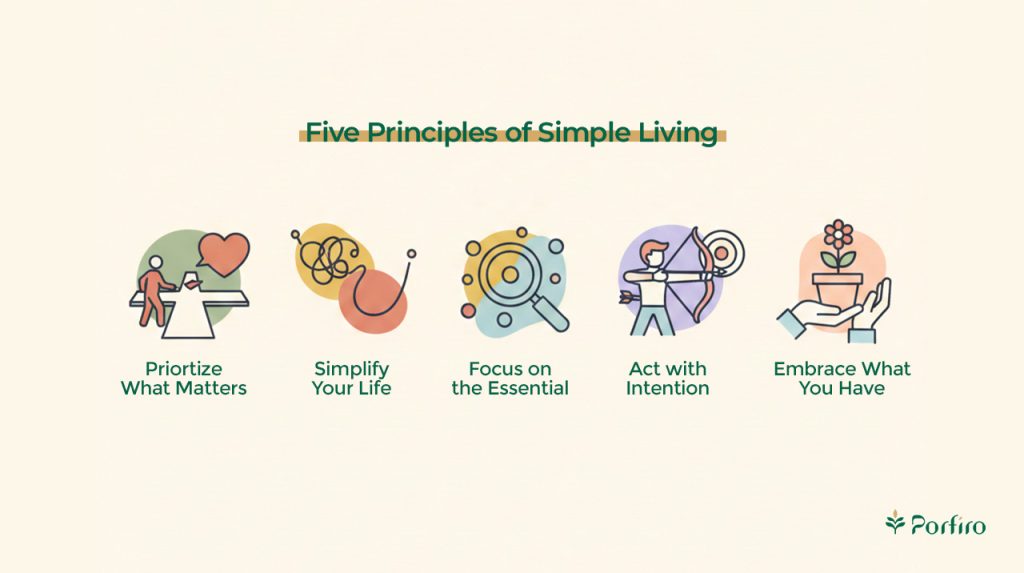
Simplicity or minimalism is all about intentionally creating a lifestyle that prioritizes the things that are important to you. The point of simplicity is to decrease stress and live a life with purpose and intent. Here are five principles of simplicity to start practicing today:
Setting priorities based on your own values allows you to focus on what is important to you. It is easier to say no to things that don’t align with them once you prioritize your values. This can mean saying no to work when someone asks you to work overtime, saying no when someone invites you to an event you have no interest in, or saying no when you see something you don’t need and don’t agree with buying for any reason that don’t align with your values.
Making a decision to choose a less complex lifestyle means taking a look and evaluating what is happening right now in your life and asking yourself what should stay and what can go by the wayside. This may mean decluttering things in your home or unsubscribing to emails in your inbox, and just about anything else that make you live a simplified life.
Focusing on the present moment helps you stay concentrated on the task at hand and prevents you from being overwhelmed by everything going on around you. When we focus on the present moment, instead of worrying about what’s next or dwelling on past decisions, we can appreciate all the little moments of our lives.
This means being aware of how our actions affect ourselves and those around us. It also means being conscious of the amount of energy we spend on certain tasks and how we use our time throughout the day, ensuring that we spend our time wisely and do not waste energy on things that add no value to us.
Most of us live in cultures and societies with the mindset of more is better. However, one of the best things we can sometimes do is find acceptance for everything we already have. Practicing gratitude for everything in our life can help us to have peace with ourselves instead of constantly chasing the next shiny object, process, experience, and/or expanding upon the materialism in our lives, which often leads dissatisfaction overtime. Being able to appreciate the current moment with everything we have in life and at our current state in life are incredibly joy-enhancing experiences.

Bearing minimalist doesn’t have to happen overnight. In fact, it’s probably better to think of it as a slow process of reflection and thought about what you’re deciding to discard and the practices you need to leave behind. Some strategies for minimalist living include:
Stress can come from so many things; work, school, relationships, the list is endless. Although it will never be feasible to eliminate any and all sources of stress in your life, it does not mean that you can’t consciously make a choice to reduce the amount of stress you have to endure on a daily basis. A conscious decision to make your life “simple”. To ‘simplify’ your life means to eliminate anything that diverts your focus from what is really important. This could mean spending less time on social media, limited impulsive shopping, etc.
The goal is to decrease the other things your mind drifts to that are not important, and shift that focus back to real life for change. Stress levels increase as the list of tasks you are trying to do at the very same time increases. Anyone that has tried to multitask can sympathize with how stressful it can be to get through a day in which you are trying to juggle several or more things at once.
Focus your energy on removing one thing from your life each week until you are fully decluttered and free from clutter in every sense, mentally and physically. You will feel calm, refreshed, and receive what everything life hands you! To reduce life stress by using minimalist living, the following can be very helpful:
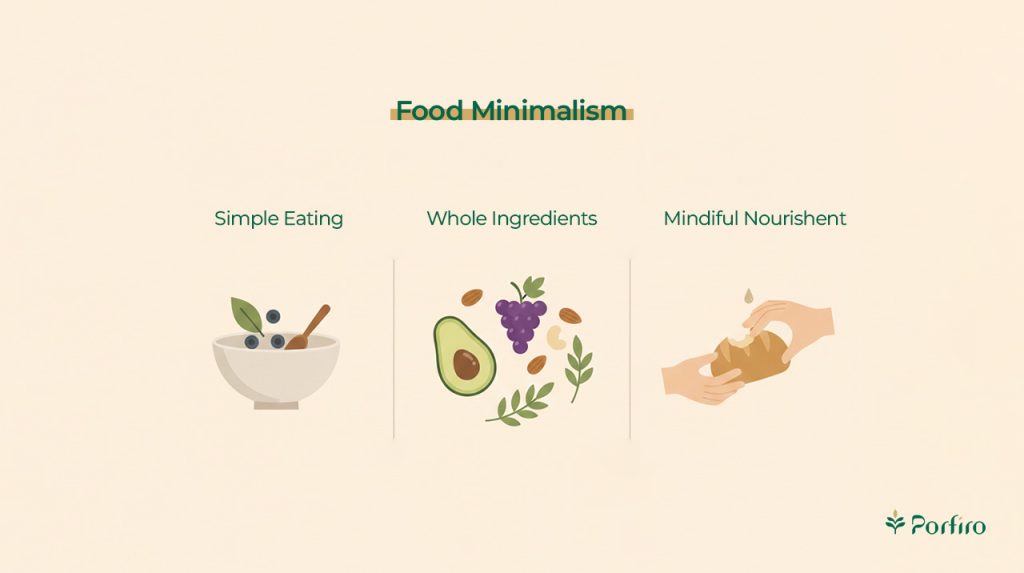
In short, a minimalist diet is any way of acquiring and eating food that prioritizes simplicity. For our purposes, any combination of foods, recipes, methods, and food choices that can be classified as minimalism will be defined as “minimalist diet.” When you are following a minimalistic approach, there are a few considerations:
Your first consideration in living a minimalist nutrition lifestyle is the nutrients you need for a healthy life. The daily ratios of protein, fats, carbohydrates, vitamins, and minerals in your diet are important for you to achieve better health, have better feelings in your body, and have more energy for all the things you actually want to do in your life. Your meals are the tools that provide your body with everything it needs to build and rebuild. First, think of food as fuel, then as pleasure; with this approach, you will move toward minimalism in your diet.
The more meals you can easily prepare, the more time you will save. The goal is to have between five to fifteen meals that don’t require much thinking but that you enjoy enough to be happy eating every night.
“Zero waste” is not a must, but considering this while shopping can be one option for a minimalist lifestyle and nutrition. If you can avoid packaged foods for most of what you consume, not only will you need less storage space for food, but the amount of waste you have to deal with will also decrease. You will also find that these food choices tend to be healthier automatically because you will be eating more natural, fresh, and whole foods.
While diets that restrict certain food groups usually have drawbacks, having 1 to 3 simple and important rules can help with simplicity. The key is to choose rules that matter to you. Avoid following rules recommended by others unless they align with your life and values. You might decide to eliminate meat, dairy, carbohydrates, processed foods, gluten, sugar, maltodextrin, acidic foods, imported foods, unsustainable foods, or any other category. The key is to understand what truly matters to you and then eat accordingly. This helps you easily remember your rules and know why you have them.
As we mentioned, you’ll want to limit the number of spices you use to only a few key spices in many dishes. Olive oil, salt and pepper are a few that come to mind right away that are staples. These items are very versatile and can be important parts of your meals. Additionally, it’s generally healthier and encourages you to appreciate the natural flavors of the foods you are eating.
When you commit to a core set of meals, you will find you only need a few essential pots, pans, utensils, and dishes. By simplifying food preparation, you can keep your kitchen tidy and everything simple and organized.
Adopting a diet with very strict rules can be great for health and weight loss but typically requires much time, thought, and energy to ensure you follow it correctly. The main goal of minimalism is to create space, not consume it. If any diet causes anxiety or requires overthinking during the day, you have violated its purpose.
This may seem obvious, but a minimalist diet can simply begin by reducing snacks. How many times a day do you eat? There are different best practices depending on your current health status, your activity level, and your basal metabolism. If you are relatively healthy and not training for a marathon, try simplifying your nutrition by eating less. Create a small guiding rule for your new habit, such as replacing your afternoon snack with a walk or avoiding eating after 8 p.m. Some people close their kitchen after washing dinner dishes to avoid night snacking. The best approach to eating less will vary from person to person; just find a place where you can reduce.
Simplicity can be found in meals that contain just a few pieces of real food: a lunch with an apple, cheese, and bread or crackers. Read food labels and try to stick to foods whose ingredients you recognize and also choose foods with the fewest ingredients. Ideal foods include fruits and vegetables that don’t even have nutrition labels. When you enter the world of processed foods, a minimalist approach may lead you to look for simpler alternatives to some of your favorite snacks. Instead of ready-made salad dressings, simply drizzle a little oil and vinegar on your salad. Instead of ordinary mayonnaise, try making your own with eggs and oil.
Attempt to lessen your diet’s effect on the planet; for instance, be vegetarian one day a week, or take a cue from Mark Bittman’s approach of going vegetarian for after 6 p.m. It takes about 25 gallons of water to produce a pound of wheat, whereas it takes about 2,500 gallons of water to produce a pound of beef. Reducing meat consumption, and replacing it with vegetables and legumes, alleviates pressure on the food production system.
Minimalism is not about asceticism; it is about simplifying your life in ways that make sense for you. Having less generally means you can buy better things. This is a huge advantage in food. If you eat less and waste less, you can buy higher quality food. Buying high-quality local products will change your perspective on fruits and vegetables. Higher upfront costs have made me more careful about food waste.
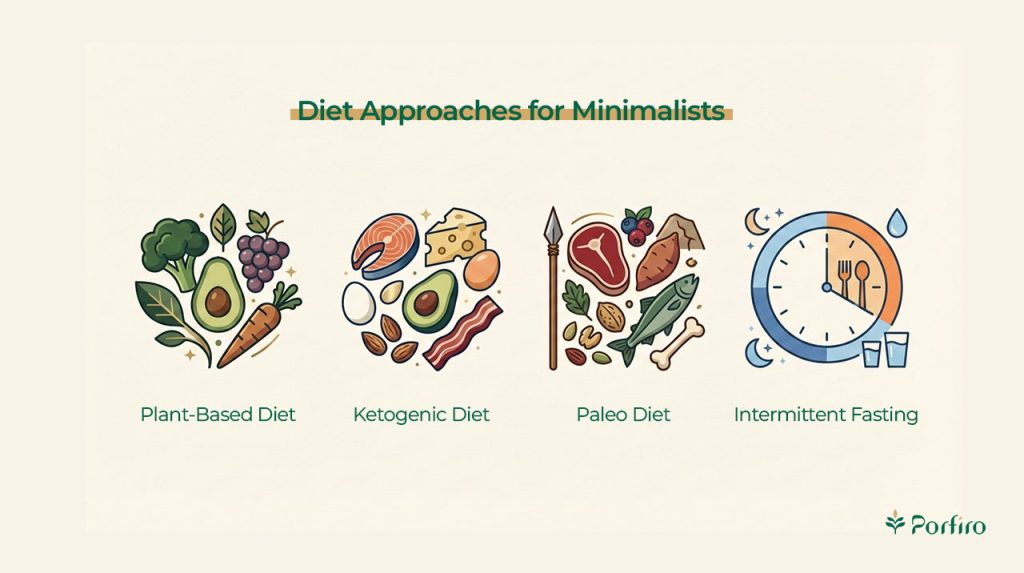
Adhering to current diets in choosing a minimalist diet can prove very useful. The majority of diets already have written guidelines, books, blogs, and articles that walk you into implementing them and following them. It is also simple to get recipes for popular diets. You are encouraged to review current diets and determine what you like and what you dislike, and then figure out how to change them to your liking and requirements.
It is perfectly fine to modify established diets in some ways to make your own plan. Having a Paleo diet but only eating fish, or having a plant-based diet but excluding free-range eggs, can be simple changes that allow you to stick to the diet longer and not have to give it as much thought.
A plant-based diet works for the minimalist lifestyle for several reasons. For your health, the earth, the well-being of animals, or simplicity, a plant-based, vegan (What is Veganism and What Do Vegans Eat?) or vegetarian diet can be a good fit. It is easy to follow because it has few rules. Plant-based diets don’t necessarily eliminate animal products altogether but make you more aware of when and what you’re eating. Vegetarian diet (Vegetarian Diet: Beginners Guide and Meal Plan) consists of no meat, fish, and poultry but has eggs and dairy. A vegan diet consists of no meat, fish, poultry, eggs, dairy, and their products.
The Ketogenic diet (Ketogenic Diet: Step-by-Step Guide to Starting), also known as “keto,” is a rather strict diet consisting of low-carbohydrate (What Are Carbohydrates? And Useful Types) and high-fat foods. This diet is formulated in a specific ratio of carbohydrates, proteins, and fats to increase ketones. There are many indications about weight loss and health benefits of this diet that you can go through reading.
The reason a ketogenic lifestyle suits minimalists is that it eliminates or limits many of the foods that would fill your pantry or your meal plan. On keto, you limit sweets, starches, fruits, legumes, processed foods, seasonings, and sauces. Whether or not this works in your life, there are definitely pluses to reducing the number of food options. The disadvantage is that for most, it involves more planning and prep.
Even though Paleo is similar to the ketogenic diet in terms of low carbs, it does allow for a little more fruit, natural sweeteners, and starch vegetables. The rule of thumb is you only eat foods believed to be discovered by Paleolithic people. This diet typically includes vegetables, fruits, nuts, roots, and meat and not dairy, grains, sugar, oils, salt, alcohol, and coffee. There are some adjustments you can make to this diet. For minimalists, the general rule of “if it didn’t exist for cavemen, don’t eat it” provides a fairly simple framework for selecting foods.
Intermittent fasting is another popular trend that can be a great way to simplify your lifestyle. Intermittent fasting is not really a diet because it doesn’t specify what foods to eat or avoid; rather, it provides guidelines on when to eat and when not to eat. You may employ varying protocols between 8 hours of fasting and 24 hours or more. There are even other methods like the 5:2 diet, where you restrict yourself to just 500-600 calories on two non-consecutive days in a week and a normal diet for the other five days.
Like any other diet, intermittent fasting possesses many supposed health advantages. On a minimalist level, intermittent fasting benefits in many ways. Cutting the number of meals cuts down on time spent mentally on food, time spent preparing food, time spent buying food, time spent eating. It may even provide a shot at discipline and focus you won’t find with other diets. Intermittent fasting can exist as an independent minimalistic model for nutrition or on top of another model.
Finally, minimalism as philosophy and way of life is all about simplifying life through the elimination of unwanted clutter and focusing on essentials. This process not only makes the enhancement of physical and mental wellness easier but also makes the individual better at work and happier in life. Healthy food intake, reducing consumption, and embracing good habits in this manner can make life a better and happier life altogether. In this article, we have explained principles and a variety of techniques that can help you lead a minimalist lifestyle.
10239
Resources